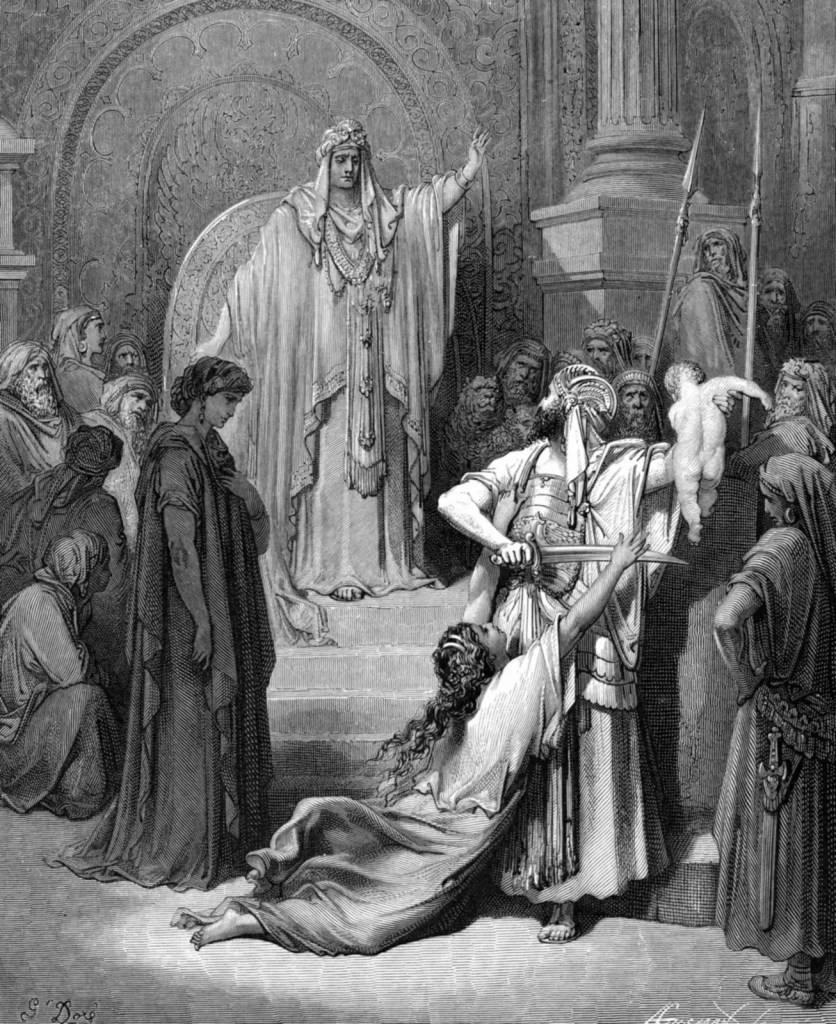
The book of Ecclesiastes is a very insightful book, and usually is highly relatable to those that are new to Christianity. With many conflicting statements made by Solomons secular worldview, certain groups such as the Jehovah’s Witnesses fail to recognize the point of view in which Solomon or “the Preacher” is coming from in terms of the Afterlife and the State of the Dead. Especially, Ecclesiastes 9:5, which states that “the dead know nothing”. Jehovah’s Witnesses and other groups abuse this text to support their esoteric view that there is cessation of consciousness after death. However, these same groups do not appeal to where Solomon says that he does not know where people go after death. Proposing that beasts and men, unrighteous and righteous go to the same place and etc;
FOR WHAT HAPPENS TO THE CHILDREN OF MAN AND WHAT HAPPENS TO THE BEASTS IS THE SAME; as one dies, so dies the other. They all have the same breath, and MAN HAS NO ADVANTAGE OVER THE BEASTS, for all is vanity. All go to one place. All are from the dust, and to dust all return. WHO KNOWS WHETHER THE SPIRIT OF MAN GOES UPWARD AND THE SPIRIT OF BEAST GOES DOING INTO THE EARTH? So I saw that there is nothing better than that a man should rejoice in his work, for that is his lot. WHO CAN BRING HIM TO SEE WHAT WILL BE AFTER HIM?
So I turned to consider wisdom and madness and folly. For what can the man do who comes after the king? Only what has already been done. Then I saw that there is more gain in wisdom than in folly, as there is more gain in light than in darkness. The wise person has his eyes in his head, but the fool walks in darkness. And yet I perceived that THE SAME EVENT HAPPENS TO ALL OF THEM. Then I said in my heart, “What happens to the fool will happen to me also. Why then have I been so very wise?” And I said in my heart that this also is vanity. For of the wise as of the fool there is no enduring remembrance, seeing that in the days to come all will have been long forgotten. HOW THE WISE DIES JUST LIKE THE FOOL!
Ecclesiastes 2:12-16 (ESV)
It is a shame that these various groups pervert Scripture and do not consider their gross literalist interpretation of Ecclesiastes. Since this logic leads to contradictions and inconsistencies within the Theology of Ecclesiastes.
These groups miss the fact that Ecclesiastes is not a robust theological book on human anthropology. Rather, the genre of Ecclesiastes is a personal narrative. Focusing on Solomon’s distaste for injustice within the world, and dealing with some of the depressing epiphanies about the natural order.
Vanity[b] of vanities, says the Preacher,
vanity of vanities! All is vanity.
What does man gain by all the toil
at which he toils under the sun?
A generation goes, and a generation comes,
but the earth remains forever.
The sun rises, and the sun goes down,
and hastens[c] to the place where it rises.
The wind blows to the south
and goes around to the north;
around and around goes the wind,
and on its circuits the wind returns.
All streams run to the sea,
but the sea is not full;
to the place where the streams flow,
there they flow again.
All things are full of weariness;
a man cannot utter it;
the eye is not satisfied with seeing,
nor the ear filled with hearing.
What has been is what will be,
and what has been done is what will be done,
and there is nothing new under the sun.
Is there a thing of which it is said,
“See, this is new”?
It has been already
in the ages before us.
There is no remembrance of former things,[d]
nor will there be any remembrance
of later things[e] yet to be
among those who come after.Ecclesiastes 1:1-11 (ESV)
Within a naturalistic worldview, one does not have expectation of the afterlife. Since Solomon is interpreting life from a naturalistic/hedonistic worldview, his view on the afterlife is as such “Life only consists of what is happening within the present realm as we see it”. So in one sense, the “dead know nothing” from a naturalistic scene. Since they cease from participating in the motion within the present-physical realm.
Ironically, the Wisdom of Solomon actually makes the same point that I am making. That Solomon worldview is the conclusion of an purely naturalistic/hedonistic worldview.
FOR THEY REASONED UNSOUNDLY, SAYING TO THEMSELVES,
“Short and sorrowful is our life,
and THERE IS NO REMEDY WHEN A LIFE COMES TO ITS END,
and no one has been known to return from Hades.
For we were born by mere chance,
and hereafter we shall be as though we had never been,
for the breath in our nostrils is smoke,
and reason is a spark kindled by the beating of our hearts;
WHEN IT EXTINGUISHED, THE BODY WILL. TURN TO ASHES,
AND THE SPIRIT WILL DISSOLVE LIKE EMPTY AIR.
OUR NAME WILL BE FORGOTTEN IN TIME,
AND NO ONE WILL REMEMBER OUR WORKS;
our life will pass away like the traces of a cloud
and be scattered like mist
that is chased by the rays of the sun
and overcome by its heat.
For our allotted time is the passing of a shadow,
and THERE IS NO RETURN FROM OUR DEATH,
because IT IS SEALED UP AND NO ONE TURNS BACK.COME, THEREFORE, LET US ENJOY THE GOOD THINGS THAT EXIST
and make use of the creation to the full as in youth.
LET US TAKE OUR FILL OF COSTLY WINE and perfumes,
and let no flower of spring pass us by.
Let us crown ourselves with rosebuds before they wither.
Let no meadow be free from our revelry;
everywhere let us leave signs of enjoyment,
because this is our portion, and this our lot.
Let us oppress the righteous poor man;
let us not spare the widow
or regard the gray hairs of the aged.
But let our might be our law of right,
for what is weak proves itself to be useless.Wisdom of Solomon 2:1-11 (NRSVUE)
Those that “reasoned unsoundly” sound alot like Solomon, and how he describes his view on the natural realm.
What does man gain by all the toil
at which he toils under the sun?
A generation goes, and a generation comes,
but the earth remains forever.There is no remembrance of former things,[d]
nor will there be any remembrance
of later things[e] yet to be
among those who come after.Ecc 1:3-4, 11 (ESV)
For what happens to the children of man and what happens to the beasts is the same; as one dies, so dies the other. They all have the same breath, and man has no advantage over the beasts, for all is vanity.[b]
Ecclesiastes 3:19 (ESV)
I perceived that THERE IS NOTHING BETTER for them than to be joyful and to do good as long as they live; also that everyone should EAT AND DRINK AND TAKE PLEASURE in all his toil—this is God’s gift to man.
In conclusion, the Book of Ecclesiastes is not a book that is written in the hopes to clearly define Human Anthropology. Rather, this is from the perspective of a secular/hedonist trying to make sence of the world, and eventually finding fulfillment in the Laws of Yahweh (Ecc 12).

 Home
Home 