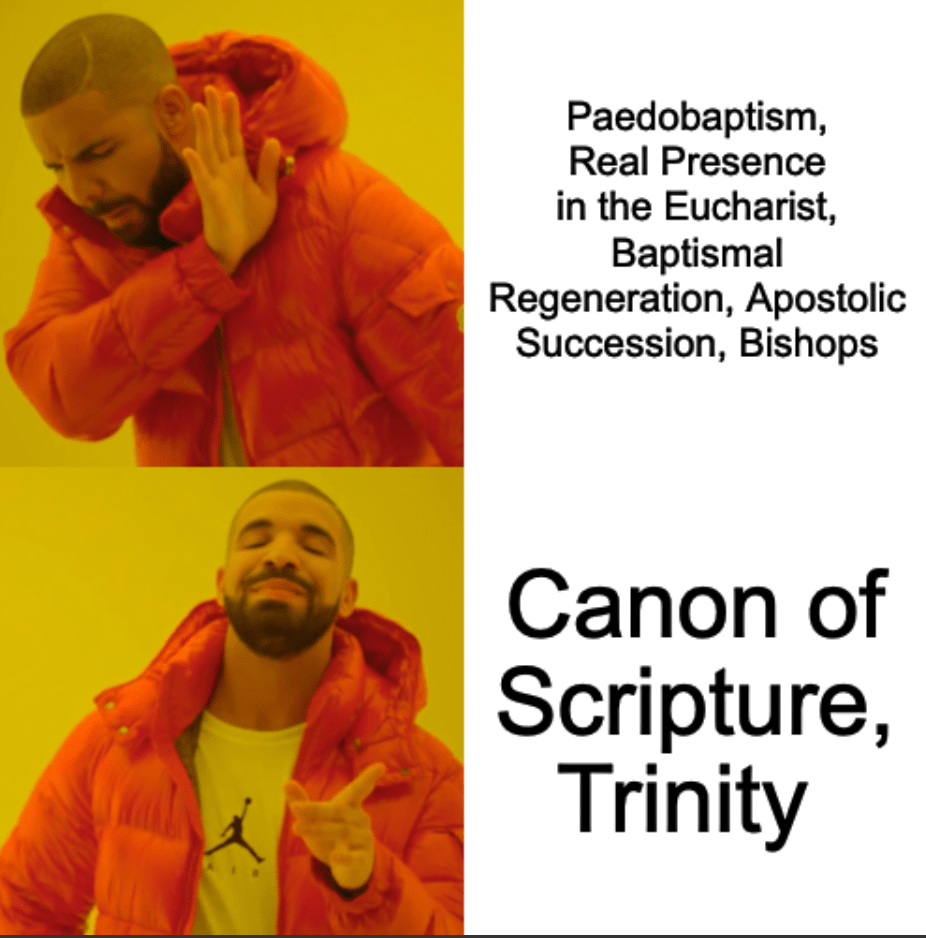
Denying the consensus and continuity of the Early Church teachings causes a person to 1) pick and choose teachings from the Early Church Fathers what supports their personal Theological framework and 2) denying the promise of Jesus, since He promised that the Gates of Hades would not prevail against the Church (Matthew 16:16-19). 3) presupposing that the Bible is paradigm independant, or in other terms the Bible “mean what they mean, and say what it says”.
At the end of the day, if you deny the Church Fathers and Apostolic Succession–(i.e. the preservation and continuity of Teaching through the providence of the Holy Spirit). You end up leaning on your own understanding—what YOU deem Biblical. YOUR own fallible, bias interpretation that is shaped by Sola Interpreta (My Interpretation alone). You become your own Pope, being able to discern what is Orthodox (what aligns with your personal Theology) and what is Heretical (what doesn’t align with your personal Theology).
Not just any Joe Shmow can pick up a Bible and be able to interpret it properly–the Bible isn’t ipso facto, it has a specific context and History “the Holy Bible is a part of Holy Tradition, but does not lie outside of it. One would be in error to suppose that Scripture and Tradition are two separate and distinct sources of Christian Faith, as some do, since there is, in reality, only one source; and the Holy Bible exists and found its formulation within Tradition” (St John’s Church – Holy Tradition).
If the Bible was so easy to read, why is there centuries of debate about theology and specific passages within the Bible? However this has been the underlying idea behind Sola Scriptura. Essentially any fella can go along and “study the scriptures“ (i.e. rejecting the Early Church on the basis that they “weren’t Biblical”, and then reviving condemned Heresy) and spread there Heresy all around town.
In Protestantism, how do you know that one Denomination is more “Biblical” than another? Let alone, how do YOU know that your interpretation is Biblical? You can’t know by personal basis. Each individual brings to the Holy Scriptures their own personal, subjective hermeneutic.
Therefore we need some type of Objective hermeneutic to contrast against the our flawed hermeneutic. This is why Sola Scriptura (Bible is the only Infallible Authority) leaves you with a Infallible Bible, but a Fallible, subjective, indefinite hermeneutic.
Instead of appealing to the Church, you become your own Church with your King James Bible and Sola Scriptura. Theology in Protestantism becomes less about One Holy Catholic and Apostolic, and more like Many Prideful Divided and Leaning on my Understanding.
This has been proven in the Reformation, with countless Schism and zero continuity within fellow Denominations. And even mini-Schism within a Schism (Infralapsarian vs Supralapsarian Calvinist for example).

Pre-Scriptural Presuppositions of Sola Scriptura
Sola Scriptura as a paradigm assumes that #1) You possess intelligibility of the Canon even though you cannot prove that objectively #2) That the Bible is ipso facto or self evident (i.e. the Bible means what it means, and says what it says, not needing an Infallible Interpretation and #3)That the Infallible Word of God is limited to the Canon of Scripture.
#1)
Sola Scriptura as a paradigm assumes that there is a way to rationally account for some type of epistemic criteria for their Canon of Scripture. The Protestant fails to complete this task, resorting to circular argumentation such as the Intrinsic Model. That the books of the New Testament within themselves can account for the Canon. This is begging the question (of the NT books themselves), or circular reasoning. One can not use what is a question to answer said question. This is not giving epistemic criteria, rather just stating the position.
As Bottom of The Rabbit Hole states “In reality, this is a false presupposition, since Protestants reject the Holy Spirit led authority of the Church in History. The Visible, Canonical, Institutional Church of the Ecumenical Councils. That was founded by the Apostles, that maintained Apostolic Succession in their Bishoprics”. Since “Protestants reject the authority of that [Apostolic] Church to bind their conscience to any teaching, belief or practice whatsoever–YET this being the same Church that decided over the course of hundreds of years what books would be in their New Testament”. This is problematic, when taking into account that all Protestants would agree that “the Church of the first Millenium teaches a false Gospel.
The believe that the Church of the First Millennium was accursed [Spirit of AnTiChRisT]. That the Church of the First Millenium, which held the Seventh Ecumenical Council that deemed rejection of Icon Veneration a heresy known as Iconoclasm. That this Church institutionalized literal idolatry into its routine liturgical worship. That for some reason, that idol worshipping, false Gospel preaching, apostate church is what the Holy Spirit providentially used to decide what books would be in [Protestants] Bible”.
In contrast to the Visible Apostate Church “the True Church, preaching the True Gospel was underground somewhere from the Last Apostle until the Reformation. And instead of using the True Church, God uses the Apostate Church providentially”.
You can not appeal to something as a standard, that your worldview precludes as false. This is a non sequitur, since the Protestant paradigm (which rejects the Church’s binding authority) can not appeal to the Historical Canonical Church for it’s Canon of Scripture. In the same way that an Atheist can not appeal to metaphysical properties such as Objective Truth. The Protestant can not appeal to the Historical Canonical Church for their Canon of Scripture.
As Bottom of the Rabbit Hole states “The Church, with its binding authority assured and guided by the Holy Spirit is a necessary prerequisite for the existence and intelligibility of the Canon of Scripture”. Since the Normative Authority (The Church) is the pre-Scriptural precondition for the intelligibility of the Canon of Scripture, and its proper Interpretation (i.e. the Impossibility of the Contrary). The Protestant position is that Scripture (which is at question), in itself is self evident and alone able to justified and bind a Protestant believer to a particular Canon of Scripture (which is circular, Canon of Scripture affirming the Canon of Scripture).
This realization has led Protestants to resort to the statement as formulated by R.C Sproul “a Fallible collection of Infallible Books”, which in itself is a logical contradiction. How can the collection of the books, be fallible, however this collection produces an Infallible Book (i.e. the Infallible relies on the Fallible).
Even if Protestants were to refer to the Church for their Bible. The Church that gave them their Canon of Scripture is not a Protestant Church (lacking continuity). For Example Canon 3 of the Council of Nicea, expressed the idea of clerical celibacy, Canon 5 talks about Lent, and Canon 18 talks about how the Eucharist is the “Body of Christ”, Canon 13 talks about giving the Eucharist to dying people. All these practices are not found within the Protestant Church today.
#2)
The presupposition of Sola Scriptura that the Bible supposedly is “self-interpretative” contradicts the critique of Foundationalism by the Coherentism paradigm. As Rev. Deacon Dr Anaias points out in his paper An Orthodox Theory of Knowledge: The Epistemological and Apologetic Methods of the Church Fathers “The error here [Foundationalism, which Sola Scriptura rests on], which the coherentist rightly points out is to think that evidence, statements, meanings, and facts are all theory-independant and can be universally approached in a neutral manner, that is that there is neutral common ground whereby we can derive facts and theories, construct arguments, etc. it becomes clear, upon reflection that what constitutes as evidence or facts will differ according to one’s own presuppositional commitments and determined by particular epistemic/theoretical paradigms.” Coherentism points out that someones presuppositional commitments/paradigms will affects how one interprets evidence and facts. Dr Anaias points out what Wilfrid Sellars argued, he said “despite [people] receiving the same sense data, all seeing will be a seeing as, a seeing according to a concept or the web of one’s beliefs and theoretical commitments”. Dr Anaias again states “What we can learn to appreciate from the coherentist (epistemic holism) theories, is that there are no theory-independent observations or meanings. All observations, therefore, are theory-contaminated/theory-laden and there are no basic meanings or epistemic givens“.
In short, all epistemic realites are influenced by some type of theory or paradigm. There is no epistemic reality that is not influenced by a paradigm. It is naive for someone to say that there is an epistemic reality that is ipso facto or paradigm independant. This reality is evident in the many Denominational division in biblical interpretation. No Protestant agrees on a universal interpretation of the Bible–which proves that the Bible is not this epistemic reality that is paradigm independent.
#3)
Scripture itself does not teach God’s Word is limited to the Bible.
Even within the 66 Book Canon of the Protestant Scripture. It alone does not prove the notion that “Scripture” is the only Infallible rule of Faith. The first example is within the Creation Narrative in Genesis “God’s Word was spoken (Genesis 1:1-3), and yet nothing was written down”. Also the fact that “from Adam to Moses, a period of several hundreds of years passed with the Revelations given to Noah, Abraham, Joseph and others being passed orally” (Jay Dyer, The Biblical Nature of Sacred Tradition).
The second example is when Abraham built an “altar to the LORD” in Genesis 12, “he didn’t have a book or written text to instruct him; he had the truths passed on from the time of Adam in the godly line of Seth, and whatever Revelations God spoke” (Dyer).
Third example is explicit, “the formation of the temple worship of God based on Sacred Oral Tradition in 2 Chron. 29 as follows, concerning King Hezekiah:
“25 And he stationed the Levites in the house of the LORD with cymbals, with stringed instruments, and with harps, according to the commandment of David, of Gad the king’s seer, and of Nathan the prophet; for thus was the commandment of the LORD by His prophets. 26 The Levites stood with the instruments of David, and the priests with the trumpets.”
But we have no written record of what David commanded concerning these things” (Dyer). It is clear that scripture alone is not the only Infallible authority within Scripture itself.
New Testament passages that do not teach that God’s Word is limited to the Bible.
2 Timothy 4:14-15
Alexander the coppersmith did me much harm. May the Lord repay him according to his works. You also must beware of him, for he has greatly resisted our words.
2 Timothy 3:14-15
But you must continue in the things which you have learned and been assured of, knowing from whom you have learned them, and that from childhood you have known the Holy Scriptures, which are able to make you wise for salvation through faith which is in Christ Jesus.
2 Timothy 3:10
But you have carefully followed my doctrine.
- 2 Timothy 1:13
Hold fast the pattern of sound words which you have heard from me, in faith and love which are in Christ Jesus.
- 2 Timothy 2:1-2
You therefore, my son, be strong in the grace that is in Christ Jesus. And the things that you have heard from me among many witnesses, commit these to faithful men who will be able to teach others also.
1 Timothy 3:15
but if I am delayed, I write so that you may know how you ought to conduct yourself in the house of God, which is the church of the living God, the pillar and ground of the truth.
1 Timothy 4:14-16
Do not neglect the gift that is in you, which was given to you by prophecy with the laying on of the hands of the eldership. Meditate on these things; give yourself entirely to them, that your progress may be evident to all. Take heed to yourself and to the doctrine. Continue in them, for in doing this you will save both yourself and those who hear you.
1 Timothy 5:17
Let the elders who rule well be counted worthy of double honor, especially those who labor in the word and doctrine.
Titus 1:7-9
For a bishop must be blameless, as a steward of God, not self-willed, not quick-tempered, not given to wine, not violent, not greedy for money, but hospitable, a lover of what is good, sober-minded, just, holy, self-controlled, holding fast the faithful word as he has been taught, that he may be able, by sound doctrine, both to exhort and convict those who contradict.
- 1 Thessalonians 2:13
For this reason we also thank God without ceasing, because when you received the word of God which you heard from us, you welcomed it not as the word of men, but as it is in truth, the word of God, which also effectively works in you who believe.
- Romans 10:17
So then faith cometh by hearing, and hearing by the word of God.
- Ephesians 1:13
In Him you also trusted, after you heard the word of truth, the gospel of your salvation; in whom also, having believed, you were sealed with the Holy Spirit of promise,
2 Thessalonians 3:5
But we command you, brethren, in the name of our Lord Jesus Christ, that you withdraw from every brother who walks disorderly and not according to the tradition which he received from us.
2 Thessalonians 2:1-2
Now, brethren, concerning the coming of our Lord Jesus Christ and our gathering together to Him, we ask you, not to be soon shaken in mind or troubled, either by spirit or by word or by letter, as if from us, as though the day of Christ had come.
- 2 Thessalonians 2:15
Therefore, brethren, stand fast and hold the traditions which you were taught, whether by word or our epistle.
“Thus, St. Peter understands that the Oral preaching he did was infallible, inspired revelation from God, as much as His written texts were. Too many glaring problems arise when we propose that the Apostles could orally teach error, and were inerrant only in written texts. And clearly the infallible biblical evidence is otherwise” (Dyer).
The Early Church didn’t teach that God’s Word is limited to the Bible.
The Earliest Christians, having continuity with the Old and New Testament. Believed in the Apostolic handing down of Tradition. Not teaching the Protestant presupposition of Sola Scriptura.
Since therefore we have such proofs, it is not necessary to seek the truth among others which it is easy to obtain from the Church; since the apostles, like a rich man [depositing his money] in a bank, lodged in her hands most copiously all things pertaining to the truth: so that every man, whosoever will, can draw from her the water of life. Revelation 22:17 For she is the entrance to life; all others are thieves and robbers. On this account are we bound to avoid them, but to make choice of the thing pertaining to the Church with the utmost diligence, and to lay hold of the tradition of the truth. For how stands the case? Suppose there arise a dispute relative to some important question among us, should we not have recourse to the most ancient Churches with which the apostles held constant intercourse, and learn from them what is certain and clear in regard to the present question? For how should it be if the apostles themselves had not left us writings? Would it not be necessary, [in that case,] to follow the course of the tradition which they handed down to those to whom they did commit the Churches?
To which course many nations of those barbarians who believe in Christ do assent, having salvation written in their hearts by the Spirit, without paper or ink, and, carefully preserving the ancient tradition, believing in one God, the Creator of heaven and earth, and all things therein, by means of Christ Jesus, the Son of God; who, because of His surpassing love towards His creation, condescended to be born of the virgin, He Himself uniting man through Himself to God, and having suffered under Pontius Pilate, and rising again, and having been received up in splendour, shall come in glory, the Saviour of those who are saved, and the Judge of those who are judged, and sending into eternal fire those who transform the truth, and despise His Father and His advent. Those who, in the absence of written documents, have believed this faith, are barbarians, so far as regards our language; but as regards doctrine, manner, and tenor of life, they are, because of faith, very wise indeed; and they do please God, ordering their conversation in all righteousness, chastity, and wisdom. If any one were to preach to these men the inventions of the heretics, speaking to them in their own language, they would at once stop their ears, and flee as far off as possible, not enduring even to listen to the blasphemous address. Thus, by means of that ancient tradition of the apostles, they do not suffer their mind to conceive anything of the [doctrines suggested by the] portentous language of these teachers, among whom neither Church nor doctrine has ever been established.
Against Heresies, Book 3, Chapter 4 (St. Irenaeus)
The fact that St Irenaeus recognises that you do not need the written scriptures in order to understand the true faith debunks the notion of Sola Scriptura. The barbarians were able to understand and preserve the Apostolic Tradition without the written scriptures. This means that #1) the Written Scriptures are distinct from the Apostolic Tradition (on the contrary to misunderstood Protestant John Peckham in Canonical Theology; “the content of tradition is nothing other than that which is also preserved in a written form, as Scripture–they are not two difference sources”; Scripture and tradition are “identical” for Irenaeus”) and #2) that Scripture alone is not needed in order to understand the true faith.
Where, therefore, the gifts of the Lord have been placed, there it behooves us to learn the truth, [namely,] from those who possess that succession of the Church which is from the apostles, and among whom exists that which is sound and blameless in conduct, as well as that which is unadulterated and incorrupt in speech. For these also preserve this faith of ours in one God who created all things; and they increase that love [which we have] for the Son of God, who accomplished such marvellous dispensations for our sake: and they expound the Scriptures to us without danger, neither blaspheming God, nor dishonouring the patriarchs, nor despising the prophets.
Against Heresies, Book 5, Chapter 26 (St. Irenaeus)
St Athanasius proclaims that it is the Historical, Canonical Church that has preserved the faith. Contrary to Protestant views on the Church, that it became apostate within history. Athanasius says that the Church is sound and blameless in conduct and is unadulterated and incorrupt in speech.
Wherefore it is incumbent to obey the presbyters who are in the Church — those who, as I have shown, possess the succession from the apostles; those who, together with the succession of the episcopate, have received the certain gift of truth, according to the good pleasure of the Father.
Against Heresies, Book 5, Chapter 26 (St. Irenaeus)
Even though St Athanasius had a high view of Scripture, he also upheld the authority of the Church. Saying that it is incumbent or obligated or required to obey the presbyters why are in a Church with Apostolic Succession.
Biblical Scholars on the Canon of Scripture
F.F Bruce explains how the Hebrew Bible was canonized;
The books of the Hebrew Bible are traditionally twenty-four in number, arranged in three divisions. the first division is the Torah (‘law’ or ‘direction’), comprising of the five ‘books of Moses’ (Genesis, Exodus, Leviticus, Numbers, Deuteronomy). The second division is the Nebiim (‘prophets’): it is further subdivided into the four Latter Prophets (Joshua, Judges, Samuel, Kings) and the four Latter Prophets (Isaiah, Jeremiah, Ezekiel, and the Book of the Twelve Prophets). The third division is called the Ketuvim (‘writings’): it comprises eleven books. First come the Psalms, Proverbs and Job; then a group of five called the Megillot or ‘scrolls’ (Song of Songs, Ruth, Lamentations, Ecclesiastes, Esther); finally Sanial, Ezra-Nehemiah (reckoned as one book), Chronicles. This is the arrangement regularly following in printed editions of the Hebrew Bible. One of the clearest and earliest statements of these three divisions and their respective contents comes in a baraitha (a tradition from the period AD 70-200) quoted in the Babylonian Talmud, in the tractate Baba Bathra. This tradition assigns inspired or authoritative authors to all twenty-four books, and discusses their order.
Bruce, F. F. (2018). The canon of Scripture. InterVarsity Press. (Page 29-30)
F.F Bruce exposits the evidence of Josephus, and how the Jewish understanding of the Canon of the Hebrew Bible.
We have not myriads of books, disagreeing and conflicting with one another, but only twenty-two, containing the records of all time, and justly accredited. Of these, five are the books of Moses, containing the laws and the history handed down from the creation of the human race right to his own death. This period falls a little short of three thousand years. From the death of Moses to the time of Artaxerxes, who was king of Persia after Xerxes, the prophets who followed Moses have written down in thirteen books the things that were done in their days. The remaining four books contain hymns to God and principles of life for human beings. From Artaxerxes to our own time a detailed record has been made, but this has not been thought worthy of equal credit with the earlier records because there has not been since then the exact succession of prophets.
When he says that since Artaxerxes’ time there has been no exact succession of prophets, Josephus does not mean that the gift of prophecy itself died out. He mentions its exercise among the Essenes, he says that the Jewish ruler John Hyrcanus I (134-104 BC) was divinely enabled ‘to foresee and foretell the future, and he claims to have had the gift himself. But in the period between Moses and Artaxerxes (465-423 BC) he appears to envisage an unbroken succession of prophets, guaranteeing the continuity and trustworthiness of the records which they were believed to have produced.
Bruce, F. F. (2018). The canon of Scripture. InterVarsity Press. (Page 32-33)
Formal Arguments against Sola Scriptura
P1: Sola Scriptura as a paradigm presupposes a fixed 66 book Canon in order to operate.

P2: A fixed Canon as an understanding is something that has developed within Church History.

C: Therefore Sola Scriptura is false.
Sola Scriptura as a paradigm presupposes that the Canon is fixed to 66 books. However, within history, the understanding of the Canon has come about gradually. This means before the realization of a fixed 66 book Canon, there was no formal Canon consisting of 66 books.
This means that there was a time within Church History that a 66 book Canon was not the understood rule of faith, and by default the Sola Scriptura paradigm is unable to operate (You can’t have your cake and eat it too!). Thus, making Sola Scriptura impossible prior to the understanding of the 66 book Canon. Since the Protestant Canon was recognized roughly around St. Athanasius (for argument’s sake). This would make Sola Scriptura paradigmatically impossible prior to St. Athanasius. And even within the time of Athanasius, Protestants would have to prove that St. Athanasius treated the Canon of Scripture as the only infallible rule of faith. And why we reject his Old Testament (including Baruch).
“Just picking a Church Father” also becomes problematic for the Protestant since there are many Fathers that had differing Canons. It is not as easy as “Just pickin’ Athanasius”. Especially when assessing the Theology of these Fathers, there is no resemblance of Protestantism (CFs’ believing in the episcopate, Church Authority, Apostolic Succession, etc).
For example Eusebius, Church Historian around the early 4th century states his New Testament Canon. Where he accepts the 27 NT Canon except 2 & 3 John, 2 Peter, Hebrews, James, and Jude.
First then must be put the holy quaternion of the Gospels [Matthew, Mark, Luke, John]; following them the Acts of the Apostles. After this must be reckoned the epistles of Paul; next in order the extant former epistle of John [1 John], and likewise the epistle of Peter [1 Peter], must be maintained. After them is to be placed, if it really seem proper, the Apocalypse of John, concerning which we shall give the different opinions at the proper time. These then belong among the accepted writings.
Among the disputed writings, which are nevertheless recognized by many, are extant the so-called epistle of James and that of Jude, also the second epistle of Peter, and those that are called the second and third of John, whether they belong to the evangelist or to another person of the same name.
Ecclesiastical History, Book 3, Chapter 25
Another example is St Cyril of Alexandria, his New Testament Canon consist everything within the 27 NT Canon except the book of Revelation.
Then of the New Testament there are the four Gospels only, for the rest have false titles and are mischievous. The Manichaeans also wrote a Gospel according to Thomas, which being tinctured with the fragrance of the evangelic title corrupts the souls of the simple sort. Receive also the Acts of the Twelve Apostles; and in addition to these the seven Catholic Epistles of James, [1 & 2] Peter, [1-3]John, and Jude; and as a seal upon them all, and the last work of the disciples, the fourteen Epistles of Paul. But let all the rest be put aside in a secondary rank. And whatever books are not read in Churches, these read not even by thyself, as thou hast heard me say. Thus much of these subjects.
Catechetical Lectures, 4. 33-37
Another example is The Cheltenham or Mommsen List, which is a “Latin list of Biblical books, probably originating in North Africa soon after the middle of the fourth century” (Metzinger, The Canon of the New Testament (Oxford, 1987), pp. 231-2.). This Canon omits Hebrews, Jude and James.
But as it was said in the Apocalypse of John, ‘I saw 24 elders casting their crowns before the throne,’ our predecessors prove these books to be canonical, and that the elders signify this.
Likewise a list of the New Testament:
The Cheltenham or Mommsen List
The Four Gospels Matthew 2700 lines Mark 1700 lines John 1800 lines Luke 3300 lines All the lines amount to 10,000 lines 7 The Epistles of Paul 13 in number 8 The Acts of the Apostles 3600 lines The Apocalypse 1800 lines 3 Epistles of John 350 lines [one only] 9 2 Epistles of Peter 300 lines [one only]. 9
Another example is the Council of Laodicea, which omits Revelation.
4 Gospels, according to Matthew, Mark, Luke, and John; the Acts of the Apostles; seven catholic epistles, namely, 1 of James, 2 of Peter, 3 of John, 1 of Jude; fourteen epistles of Paul, 1 to the Romans, 2 to the Corinthians, 1 to the Galatians, 1 to the Ephesians, 1 to the Philippians, 1 to the Colossians, 2 to the Thessalonians, 1 to the Hebrews, 2 to Timothy, 1 to Titus, and 1 to Philemon.
Council of Laodicea
Another example is St Gregory of Nazianzus a great defender of the Orthodox faith, his NT Canon omits Revelation.
Now count also those of the new mystery. Matthew wrote the miracles of Christ for the Hebrews, Mark for Italy, Luke for Greece; John for all, the great herald, who walked in the heavens. Then the acts of the wise apostles. Of Paul there are fourteen epistles. And the seven catholic, [which include] one of James, two of Peter, three of John also; and Jude is the seventh. You have them all.
Another example is Amphilochius of Iconium, cousin of St Gregory of Naziansus and served as a Bishop in Iconium. He accepts the 27 NT books however he explains how there is debate about Hebrews and Revelation.
Accept only four Evangelists, Matthew, then Mark, to which Luke as third add; count John in time as fourth, but first in sublimity of dogma. Son of Thunder rightly he is called, who loudly sounded forth the Word of God. Accept from Luke a second book also, that of the catholic Acts of the Apostles. Add to these besides that Chosen Vessel, Herald of the Gentiles, the Apostle Paul, writing in wisdom to the churches twice seven epistles, one to the Romans, to which must be added two to the Corinthians, and that to the Galatians, and to the Ephesians, after which there is the one to the Philippians, then those written to the Colossians, to the Thessalonians two, two to Timothy, and to Titus and Philemon one each, and to the Hebrews one. Some call that to the Hebrews spurious, but they say it not well; for the grace is genuine. What then is left? Of the Catholic epistles some say seven, others only three must be accepted: one of James, one of Peter, one of John, otherwise three of John, and with them two of Peter, and also Jude’s, the seventh. The Apocalypse of John, again, some approve, but most will call it spurious. This would be the most unerring canon of the divine scriptures.
Amphilochius of Iconium
Another example is the “Apostolic Canons”, which is derived from an ancient Syrian book of church order. This Canon accepts the general 27 NT Books, however adds two epistles of Clement, and a writing called “the Constitutions”.
And ours, that is, of the New Testament, are the four Gospels, of Matthew, Mark, Luke, John; the fourteen epistles of Paul; two epistles of Peter; three of John; one of James; one of Jude; two epistles of Clement; and the Constitutions dedicated to you, the bishops, by me, Clement, in eight books, which it is not appropriate to make public before all, because of the mysteries contained in them; and the Acts of us, the Apostles.
The “Apostolic Canons“
Another example is the Canon of Melito, which omits Nehemiah, Lamentations and Ezra.
Melito of Sardis’ list of the OT canon:
The five books of Moses: Genesis, Exodus, Leviticus, Numbers, and Deuteronomy,
Joshua, the son of Nun, Judges, Ruth,
Four books of Kingdoms [1-2 Samuel, 1-2 Kings], two books of Chronicles,
The Psalms of David,
The Proverbs of Solomon and his Wisdom, Ecclesiastes, the Song of Songs, Job,
The prophets Isaiah, Jeremiah, the twelve in a single book,
Daniel, Ezekiel, Ezra
Some point of interest in this list:
1. The book of Esther is not mentioned.
2. The book of Lamentations is not mentioned, but it is likely included with Jeremiah.
3. The book of Nehemiah is not mentioned, but it might have been included with Ezra.
The reason why I have displayed varying canons from various Church Fathers is to show the absurdity of “just picking a Church Father for the Canon”. Which Canon? Which Father and why? There is an obvious disagreement among the Fathers on what the Canon is.
The Protestant position has been proven to be absurd by the fact that there was many different Canons in the Early Church. Also that the Church was not dogmatic about making sure there was a definite Canon to operate Sola Scriptura. Further proving that Sola Scriptura is foreign within the mind of the Early Church.
As New Testament Professor Stephen Voorwinde exclaims in his paper The Formation of the New Testament Canon;
From its earliest days the Christian community was aware that it had a body of writings equal in authority to the Old Testament and equally revelatory in character. However, the recognition of a closed collection of documents above all other literature was a gradual process that was not complete till the end of the fourth century.
The Formation of the New Testament Canon, Stephen Voorwinde

 Home
Home 